

The dream of location independence and financial freedom has often been tied to one concept: passive income. For years, building a true passive income stream required either significant capital to invest or a vast audience to monetize. Today, the rules have changed. We are witnessing a paradigm shift in how digital services are built and sold, driven by the democratization of artificial intelligence.
Welcome to the era of AI as a Service (AIaaS) . This isn’t about building the next ChatGPT; it is about leveraging existing AI tools to create automated, scalable services that solve real problems for businesses and individuals .
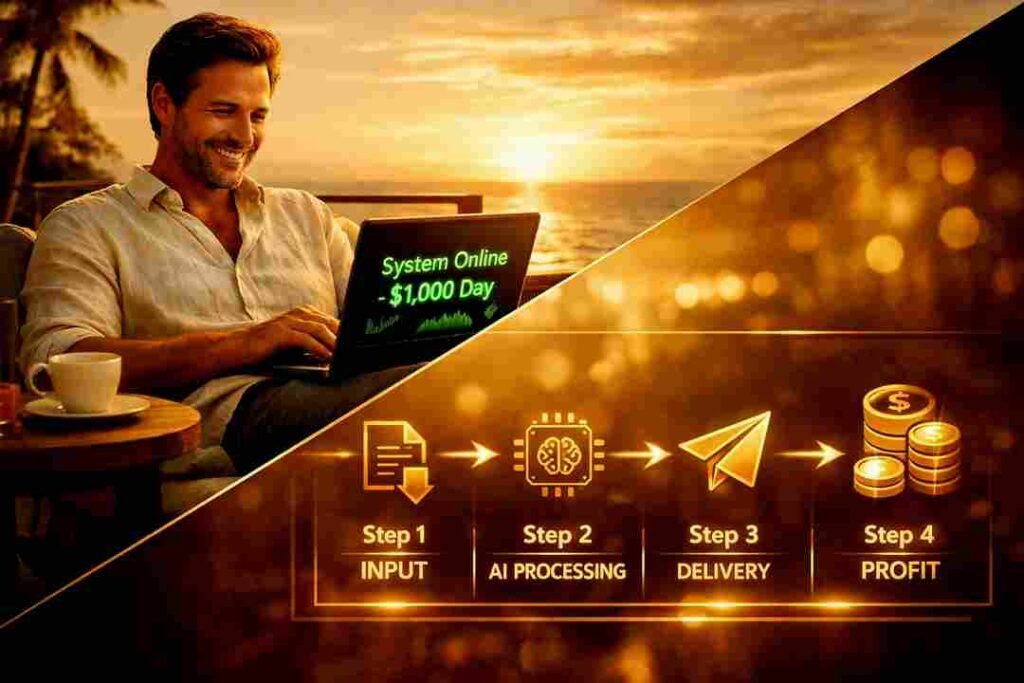
At the core of this movement is a simple, repeatable framework. Today, I am sharing our proven 4-step “AI-as-a-Service” business model that we use to stack $1,000 days on autopilot. The best part? You can copy and paste this blueprint to launch your own automated income stream.
What is AI as a Service (AIaaS)?
Before we dive into the steps, it’s crucial to understand the landscape. AI as a Service (AIaaS) refers to the outsourcing of artificial intelligence capabilities by utilizing pre-built AI tools and APIs from third-party providers . Think of it like SaaS (Software as a Service). Instead of installing software on your computer, you access it via the cloud. With AIaaS, instead of building complex AI models from scratch, you access them through a provider to perform specific tasks .
This model allows entrepreneurs and small businesses to integrate powerful AI capabilities—like natural language processing, image recognition, and predictive analytics—into their operations without needing a team of data scientists . This accessibility is the foundation of our business model.
Step 1: Niche Selection & Packaging “Outcomes”
The biggest mistake new entrepreneurs make is leading with the technology. They say, “I sell an AI content tool.” Clients don’t buy tools; they buy outcomes. They don’t want a prompt; they want fewer support tickets or faster pipeline velocity .
Our first step is to identify a specific, repetitive problem in a specific market and package an AI solution that delivers a clear outcome. This is where keyword research becomes your best friend. You need to find the “transactional” and “informational” keywords your target audience is using to find solutions .
For example, instead of a broad “AI writing assistant,” we package specific services:
- For Realtors: “Automated Luxury Home Listing Descriptions”
- For E-commerce Stores: “SEO-Optimized Product Description Generator”
- For Consultants: “Automated Meeting Summary & Action Item Generator”
Actionable Tip: Use tools like Ahrefs or even Google’s “People Also Ask” to find long-tail keywords with clear intent . Search for phrases like “automated report generation for [industry]” or “AI tool for [specific task].” The more specific your niche, the higher your perceived value and the less competition you will face.
Step 2: Building the Automated “Agent” Workflow
Once you have identified the service, the next step is to build the machine that does the work. We are moving beyond simple chatbots to what is known as agentic AI. These are autonomous systems that can handle complex tasks without human supervision .
You don’t need to be a programmer to do this. Platforms and APIs allow you to build an “agent” that handles the workflow under the hood . This is where the “automation” in “autopilot” comes from.
Here is how you build the workflow:
- Input: Create a simple way for the client to submit their data. This could be a form (like a Google Form), an email forward, or a direct upload to a shared drive.
- The AI Brain: Use APIs from providers like OpenAI or open-source models to process the data. The key is to use a “right-sized” agent—keeping each agent scoped to a specific task (e.g., one agent for research, one for writing) .
- Output: The AI generates the final deliverable. This could be a document, a spreadsheet, or a report.
For non-interactive jobs like nightly reports or batch content creation, you can use batch processing APIs to cut costs by up to 50% . This is how you ensure your margin stays high.
Step 3: The “Set & Forget” Pricing and Delivery Model
Automation is only half the equation for passive income. The other half is a delivery model that doesn’t require your active time. This is achieved by packaging your service into a subscription model .
Our framework relies on two primary pricing strategies, depending on the service:
- Subscription Model (The Goal): For “always-on” outcomes, like daily competitive analysis reports or ongoing social media content creation, a monthly subscription is ideal. It provides predictable, recurring revenue. This aligns with the SaaS mindset that customers are already comfortable with .
- Per-Task Pricing: For clear, one-off deliverables (e.g., “Generate 50 high-converting ad variants”), you can quote a flat fee. Estimate your input/output tokens and tool calls, add a healthy margin, and you have a profitable product .
The magic is in the integration. Once the workflow is built and the payment is processed (via Stripe or a similar platform), the entire delivery is automatic. The customer submits a request, the AI agent processes it, and the finished product is delivered to their inbox or dashboard—all without you lifting a finger.
Step 4: Scale with Automation and Diversification
With a functioning, automated service bringing in monthly revenue, the final step is to scale. Because your delivery is automated, your marginal cost for each new customer approaches zero.
Scaling isn’t just about getting more customers; it’s about making your existing systems more robust and expanding your offerings. Consider these growth tactics:
- Diversify Income Streams: Once you have one successful AI service, use the same framework to build another. For example, if you have a “Newsletter Generator,” you could also offer “AI-Powered Lead Scoring” or “Automated Podcast Transcription and Show Notes” .
- Create Digital Products: Package your proven prompt templates and workflow guides into a digital product. This adds another zero-effort income stream .
- Optimize for Efficiency: Use analytics to monitor your API costs and latency. Split traffic between “priority” and “flex” tiers to manage costs and performance as you scale .
By creating a suite of tools or expanding your service to enterprise clients, you can significantly increase your monthly potential from $1,000 days to $10,000+ months .
The Bottom Line
The AI revolution isn’t coming; it’s already here, and it’s handing the means of production back to the individual. The barriers that once protected large corporations—prohibitively expensive infrastructure and a scarcity of specialized talent—have crumbled .
By following this 4-step model, you are not just building a business; you are designing a lifestyle. You are moving from trading time for money to building an asset that works for you 24/7. The time for experimentation is over. It is time to package, automate, and scale. Your $1,000 days are waiting.
Beyond the Hype: Why Your Business Needs an AI Smart Dashboard
