

In today’s fast-paced digital landscape, business leaders are drowning in data but starved for insights. You might have a stack of different software subscriptions—one for sales, another for marketing, a spreadsheet for finances, and a separate analytics tool for your website. The result? Fragmented information and a heavy cognitive load just to answer the simple question: “How is the business actually doing?”
Enter the AI Smart Business Dashboard. This isn’t just another analytics tool; it is a paradigm shift. It promises “Everything Your Business Needs In One AI Platform,” but what does that actually look like in practice? It means moving from manually stitching together reports to having a central “control tower” that not only visualizes your data but understands it, predicts outcomes, and tells you what to do next .
In this post, we’ll explore how AI-powered dashboards are transforming operations, the key features that separate them from traditional business intelligence, and why having an all-in-one platform is the secret weapon for modern growth.
What is an AI Smart Business Dashboard?
Traditionally, a business dashboard was a static display of charts and graphs. It showed you what happened last week or last month. An AI Smart Dashboard, however, is dynamic and intelligent. It uses artificial intelligence—specifically Large Language Models (LLMs) and machine learning—to allow users to interact with their data conversationally .
Imagine asking your dashboard, “What were our top-selling products last quarter, and why did sales dip in the western region?” Instead of waiting days for a data analyst to write a complex SQL query, the AI translates your plain English question into code, fetches the data, and presents a summary with root-cause analysis in seconds . This is the power of an “all-in-one” platform: the ability to query every facet of your business in real-time.
Key Features of an All-In-One AI Platform
When we talk about having “everything in one place,” it goes beyond just viewing data. A robust AI business dashboard combines several layers of intelligence:
1. Conversational Analytics
The days of complex filters and drill-down menus are fading. Modern AI dashboards utilize Natural Language Processing (NLP) to create a dialogue with your data . You can ask follow-up questions just as you would with a human analyst. For example:
- User: “Show me monthly sales trends.”
- AI: [Generates a chart]
- User: “Now break that down by the marketing campaign source.”
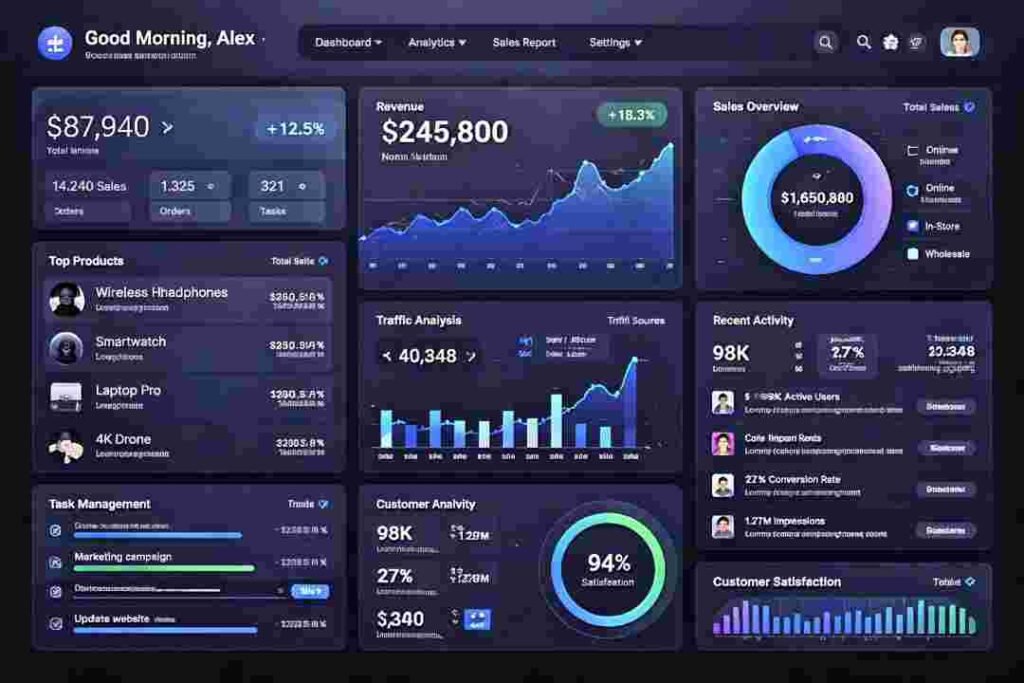
This back-and-forth capability, known as conversational analytics, makes data exploration accessible to everyone in the company, not just data scientists .
2. Automated Insight Generation
An AI dashboard doesn’t just wait for you to find problems; it proactively alerts you. This is often called anomaly detection . The system continuously monitors your Key Performance Indicators (KPIs). If there is a sudden spike in website traffic or an unexpected drop in conversion rates, the dashboard instantly notifies you and attempts to explain the “why” behind the anomaly .
3. Predictive & Prescriptive Analytics
While traditional BI answers “What happened?”, AI answers “What will happen?” and “What should we do about it?”.
- Predictive Analytics: The dashboard uses historical data to forecast future trends, such as inventory demand or customer churn rates .
- Prescriptive Analytics: Going a step further, the AI recommends specific actions. For instance, it might notice a delivery delay and automatically suggest re-routing shipments or notifying affected customers before they complain .
4. Unified Data Architecture
The “all-in-one” promise relies on the platform’s ability to sit on top of all your existing data sources. Whether your data lives in a cloud data warehouse like Snowflake or Databricks, a CRM like Salesforce, or project management tools like Jira, a true AI dashboard connects to everything, creating a single source of truth . As seen with platforms like Databricks One, this abstraction layer means non-technical users don’t need to know where the data comes from; they just need to ask the question .
The Strategic Shift: From Dashboard to “Control Tower”
To truly understand the value, think of your AI dashboard not just as a reporting tool, but as a Strategic Control Tower .
company transformed its IT dashboard into a mission-control center. Instead of just tracking server uptime, the new AI-driven tower integrated data from IT, finance, HR, and operations. It provided live alerts on budget deviations and flagged conflicts between project backlogs .
This is the essence of the “everything in one platform” philosophy. It breaks down silos. The marketing team can see how their campaigns impact the supply chain. The finance team can see how engineering sprints affect cash flow. This holistic view fosters better collaboration and faster, more confident decision-making.
SEO and Content Integration
Interestingly, the power of AI dashboards extends into your digital presence as well. For businesses focused on growth, having an AI dashboard that integrates SEO data is a game-changer. Some platforms now offer tools for meta title and keyword generation, content enrichment, and competitive analysis directly within the interface .
Imagine an AI tool that not only tells you that your competitor is ranking for a specific keyword but also generates a content outline for you to compete with them, and then tracks your ranking progress over time—all within the same dashboard . This turns your business intelligence platform into an active participant in your revenue generation, rather than just a passive observer.
The 2026 Scale-Up Playbook: Turn AI Prompts into Automated Profit Machines
see now
Getting Started with Your AI Dashboard
Transitioning to an AI-driven, all-in-one platform might seem daunting, but the path to adoption is simpler than you think. Here is a quick implementation playbook:
- Start with a Single POC: Don’t try to boil the ocean. Pick one specific use case, such as “conversion anomaly alerts” for your e-commerce site, and prove the ROI there before scaling .
- Prioritize Data Trust: An AI is only as good as its data. Ensure your data pipelines are clean and that the platform offers transparent reasoning (explaining how it arrived at a conclusion) to build trust with your team .
- Focus on Action, Not Just Visualization: The goal is to reduce the time between insight and action. Choose a platform that integrates with your workflow tools (like Slack or Teams) so alerts and reports land where your team already works .
Conclusion
The era of static dashboards and reactive decision-making is over. An AI Smart Business Dashboard that truly offers everything your business needs in one platform is no longer a luxury—it is a necessity for staying competitive.
By unifying your data, providing conversational access to insights, and predicting future trends, AI empowers your entire team to act with confidence and speed. It’s time to stop compiling reports and start orchestrating your business’s future.
